Your team maps its strengths, resources and working relationships. Different perspectives meet in one shared picture, giving people a common language for what is happening and a stronger foundation for working towards the goal.
An experiential toolResources · Contributions · Connections
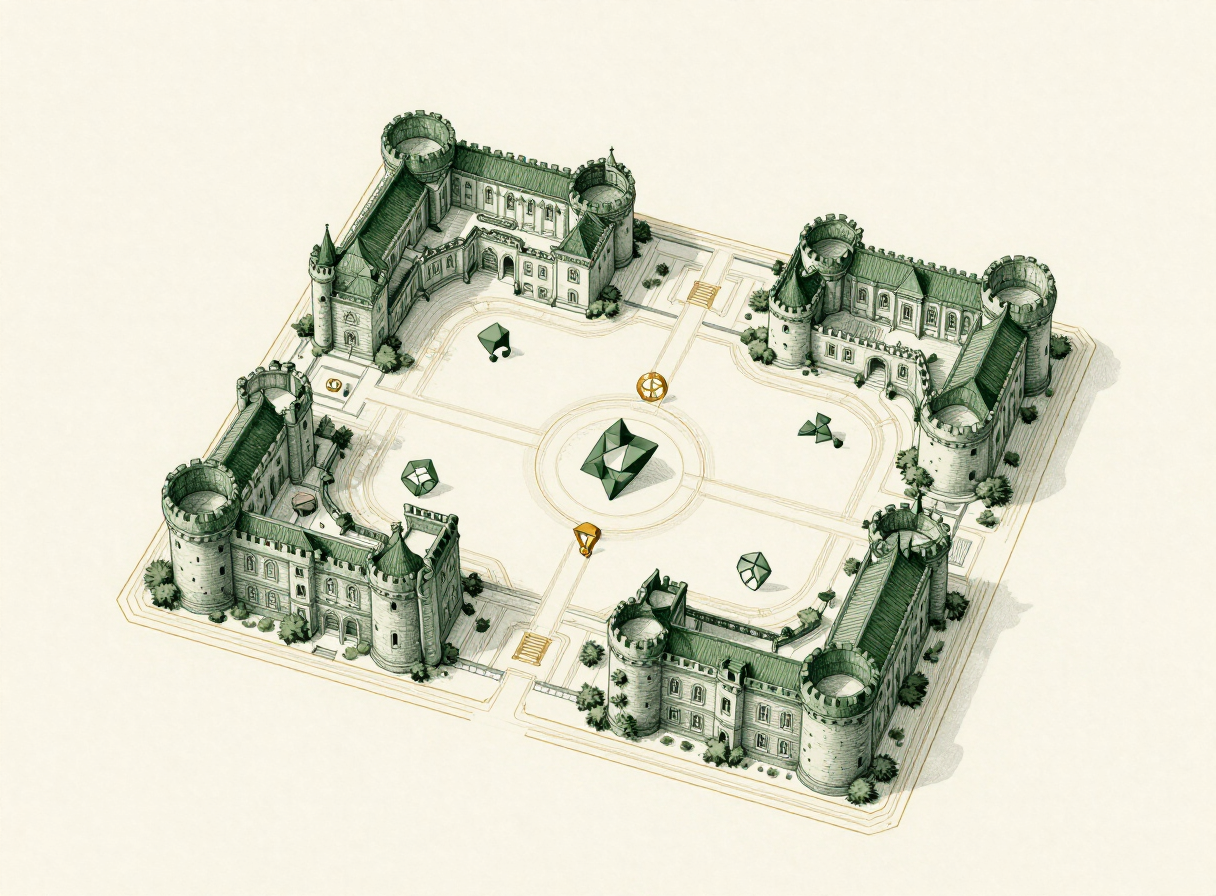
Illustrative image.
Experiential team development
Make the invisible easy to discuss.
The Castle Method uses a shared picture to explore how a team works. It gives people a tangible way to discuss strengths, contributions and connections without fixing them into labels.
Seeing each contribution in relation to the whole matters because most teams get stuck not in any single part, but in the connections between them. A person's work makes sense differently when placed beside the resources it draws on and the handovers it depends on.
Grounded in Gestalt informed organisational development, the approach focuses on awareness, presence and dialogue in work, collaboration and action. The Castle Method is one tool within our wider Gestalt informed organisational work, not the whole concept.
01
Map
Place resources and contributions.
Participants explore their strengths, resources and contributions using room cards, movement and drawing. The team builds a shared picture and discusses where contributions connect and where expectations differ.
Intended output: a shared picture of how the organisation works.
02
Connect
See where work flows and gets stuck.
The team looks at connections between vision and strategy, innovation, production, knowledge and resources, cross team flow and execution. Patterns from individual perspectives are brought into guided conversation.
Intended output: key themes and a shared team picture.
03
Act
Agree priorities and next steps.
The team agrees two or three priorities with named owners, practical next steps and review dates. Follow up creates space to review what has been tried and what needs adjusting.
Intended output: agreed priorities, owners and a reviewable action plan.